Persistent Hip and Groin Pain Successfully Treated in Yokohama
Do You Experience Any of These Symptoms?
- Pain in the groin or front of the hip while walking
- Persistent discomfort after playing soccer or futsal
- Hip pain that worsens after prolonged sitting
- Groin pain despite normal X-rays
- Hip pain that returns shortly after massage or manual therapy
- Pain during sports involving running, kicking, or sudden changes of direction
- Looking for long-term relief rather than temporary symptom management
If these symptoms sound familiar, you may be experiencing Groin Pain Syndrome (also known as Athletic Groin Pain).
Groin pain is common among athletes participating in sports such as soccer, futsal, rugby, hockey, and tennis. However, it can also occur in recreational athletes after returning to exercise following a long period of inactivity.
This case report describes a woman with persistent right hip and groin pain lasting more than six months, despite medical treatment and various forms of conservative care.
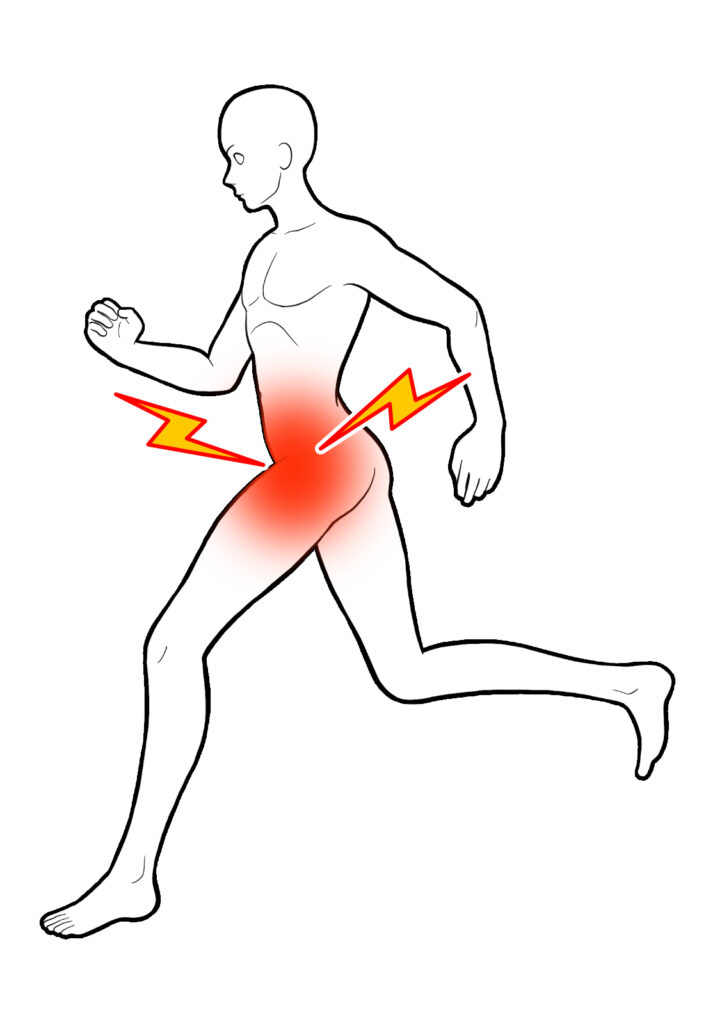
A woman in her 30s visited Spine Chiropractic complaining of persistent pain extending from the front of her right hip into the groin.
Her symptoms began approximately six months earlier after playing futsal for the first time in nearly three years.
Initially, she assumed the discomfort was simply muscle soreness from returning to exercise after a long break.
However, instead of improving over time, the discomfort gradually became a constant daily problem.
She described:
- Persistent discomfort while walking
- A dull ache during prolonged sitting at work
- Pain that gradually spread from the groin into the front of the hip
- Increasing discomfort in the right buttock and lower back as she unconsciously compensated for the pain
Although she did not experience numbness or neurological symptoms, the constant discomfort had become emotionally exhausting.
She explained,
“I’ve had this discomfort every day for six months. It’s beginning to affect me mentally because it never completely goes away.”
Concerned about the persistent symptoms, she visited an orthopedic clinic.
After obtaining X-rays, she was told that no bony abnormalities were present.
She was prescribed anti-inflammatory medication and topical patches, but her symptoms remained unchanged.
A second consultation resulted in essentially the same recommendation.
Feeling that her recovery had reached a standstill, she decided to search for other treatment options.
She subsequently visited several massage therapy and manual therapy clinics.
Although these treatments temporarily reduced her discomfort, the symptoms typically returned the following day and gradually returned to their previous level within several days.
Having never received chiropractic care before, she searched Google Maps for an English-speaking chiropractor and found Spine Chiropractic.
After reading patient reviews and exploring our website, she decided to schedule an appointment.
[Initial Symptoms]
Patient History
The patient reported that the discomfort began immediately after playing futsal for the first time in several years.
Rather than improving naturally, the pain gradually became chronic.
Although the intensity of the pain was moderate, the constant nature of the symptoms significantly affected her quality of life and emotional well-being.
She described discomfort primarily in the right groin and anterior hip, with prolonged walking causing the symptoms to gradually spread throughout the hip region.
Postural Assessment
During the consultation, while seated, the patient unconsciously shifted most of her body weight toward the left side in an apparent attempt to reduce loading on the painful hip.
When lying in the supine position, the right lower extremity rested in greater external rotation than the left, with the right foot naturally pointing outward.
These findings suggested altered hip mechanics and compensatory pelvic positioning.
Static Palpation
Palpation revealed marked hypertonicity throughout the muscles responsible for hip abduction, particularly around the lateral hip.
In contrast, the adductor muscle group demonstrated relatively reduced resting tone.
Visible asymmetry of the gluteal region was also observed while the patient was lying supine, suggesting altered pelvic and hip muscle balance.
Motion Palpation
Lumbar spine flexion and extension were both pain-free, with normal spinal range of motion.
Hip assessment demonstrated:
- Groin discomfort during passive hip flexion
- Reproduction of symptoms during external rotation
- Pain during hip abduction
Standing assessment revealed discomfort involving the buttock, hip joint, and groin throughout nearly the entire range of hip movement, including extension.
Single-leg loading of the unaffected (left) side required weight-bearing through the symptomatic right hip.
This immediately reproduced the patient’s familiar groin pain and demonstrated a noticeable lateral pelvic shift toward the right, indicating reduced pelvic stability and altered hip biomechanics.
Orthopedic Examination
A comprehensive orthopedic examination was performed to evaluate the hip joint and surrounding structures.
The following findings were obtained:
- Trendelenburg Test: Positive
- Patrick (FABER) Test: Positive
- Laguerre Test: Positive
- Thomas Test: Negative
- Nachlas Test: Negative (although quadriceps flexibility was reduced)
- Ely’s Test: Positive on the right
No neurological findings suggested lumbar radiculopathy or significant nerve involvement.
Based on the patient’s history, physical examination, movement assessment, and orthopedic testing, her symptoms were considered most consistent with Groin Pain Syndrome (Athletic Groin Pain) associated with dysfunction of the hip, pelvis, and surrounding soft tissues.
[Chiropractic Treatment for Groin Pain Syndrome]
Based on the patient’s history, physical examination, and movement assessment, no serious hip pathology or neurological disorder was suspected.
Instead, the clinical findings suggested that the patient’s symptoms were most consistent with Groin Pain Syndrome (Athletic Groin Pain), with mechanical stress involving the inguinal ligament considered the primary contributor.
In Japan, chiropractors are not legally permitted to make medical diagnoses. The working diagnosis described here represents a clinical hypothesis based on the patient’s history and examination findings.
Groin Pain Syndrome is not a single injury but rather a collection of conditions that may involve multiple structures, including the:
- Inguinal ligament
- Hip flexor muscles
- Adductor muscles
- Hip joint
- Pelvis
- Pubic region
- Core musculature
For this patient, the most significant finding was marked discomfort during hip external rotation, suggesting excessive mechanical tension across the inguinal ligament and surrounding soft tissues.
Treatment therefore focused on reducing this abnormal stress while restoring normal hip and pelvic biomechanics.
Initially, soft tissue therapy was performed around the inguinal ligament, extending from the pubic region toward the anterior superior iliac spine (ASIS), to improve tissue flexibility and reduce tension around the painful area.
Biomechanical assessment also revealed excessive external rotation of the right hip together with altered pelvic alignment.
To improve hip mechanics, chiropractic adjustments were applied to restore normal motion of both the pelvis and right hip joint, reducing abnormal loading through the anterior hip and groin.
Additional soft tissue treatment was directed toward muscles contributing to excessive hip external rotation, including the:
- Gluteal muscles
- Tensor fasciae latae (TFL)
- Vastus lateralis
- Deep hip rotators
Reducing tension in these muscle groups helped decrease abnormal mechanical stress across the hip and groin during walking and sporting activities.
Finally, the patient received individualized rehabilitation advice, including:
- Hip mobility exercises
- Gluteal strengthening
- Core stabilization exercises
- Pelvic control exercises
- Warm-up and recovery strategies before and after futsal
The primary objective was not only to relieve pain but also to restore efficient movement patterns and reduce the likelihood of recurrence when returning to sport.
Treatment Progress
First Visit
Immediately following treatment, hip mobility and symptom reproduction were reassessed.
Before treatment, passive movement of the right hip consistently reproduced the patient’s familiar groin pain.
Following treatment, these symptoms were no longer provoked during passive examination.
The patient also reported a substantial reduction in pain while walking and described the hip as feeling noticeably lighter.
“The discomfort is much less than when I came in today.”
Because the symptoms had persisted for approximately six months, a follow-up appointment was scheduled one week later to monitor her response.
Second Visit (One Week Later)
At her second appointment, the patient reported that normal walking was now essentially pain-free.
However, she had returned to playing futsal two days before her visit, and the groin pain recurred during the match.
This indicated that although her symptoms had improved during daily activities, the hip had not yet fully tolerated the higher mechanical demands of sport.
Treatment again focused on restoring hip and pelvic mechanics while expanding the assessment to include the knee.
Restricted patellar mobility and increased tension within the popliteus muscle were identified on the right side compared with the unaffected knee.
These findings suggested additional biomechanical compensation throughout the lower kinetic chain and were incorporated into the treatment plan.
A further review was scheduled one week later.
Third Visit (One Week Later)
The patient returned after playing futsal again.
This time, she reported only mild discomfort rather than significant pain.
She explained that although she could still feel some awareness around the groin, it no longer interfered with her performance.
The same treatment approach was continued, focusing on restoring normal hip mobility, pelvic stability, and lower-limb biomechanics.
Because she demonstrated continued improvement, the interval between visits was increased to two weeks.
Fourth Visit (Two Weeks Later)
At her fourth visit, the patient reported that her groin pain had completely resolved during normal daily activities.
She had played futsal twice since her previous appointment and was pleased to report significant improvement after both games.
She estimated that, compared with her initial presentation,
her symptoms had improved from 10/10 to approximately 3–4/10, even after playing futsal.
As her hip function continued to normalize, treatment shifted from addressing the local groin symptoms to improving overall movement throughout the lumbar spine, pelvis, thoracic spine, and lower extremities.
The emphasis moved toward optimizing whole-body mobility, flexibility, and movement efficiency to reduce the risk of future recurrence.
Maintenance Phase
The patient’s symptoms are now almost completely resolved.
Because she has returned to regular sporting activities, ongoing care is focused on maintaining optimal hip and pelvic function rather than treating active pain.
We discussed transitioning from active treatment to a monthly maintenance chiropractic program, with periodic reassessment to help minimize the risk of future groin injuries and support long-term athletic performance.
[Clinical Perspective]
This case is representative of a common presentation of Groin Pain Syndrome (Athletic Groin Pain) seen in physically active individuals.
Groin pain frequently affects athletes participating in sports such as soccer, futsal, rugby, hockey, and tennis—activities that require repeated sprinting, kicking, cutting, pivoting, and rapid changes of direction.
These movements place considerable mechanical stress on the hip joint, pelvis, groin, knees, and surrounding soft tissues.
As a result, structures such as the inguinal ligament, hip flexors, adductor tendons, abdominal muscles, cartilage, and other stabilizing tissues may become overloaded and painful.
In the acute stage, these injuries are often accompanied by inflammation, resulting in sharp pain during movement and, in some cases, pain even at rest.
Fortunately, by the time this patient presented to our clinic, the acute inflammatory phase had largely resolved.
This allowed us to begin a more active rehabilitation program aimed at restoring normal movement rather than simply protecting the injured tissues.
One of the most common findings in patients with chronic groin pain is the development of a self-perpetuating cycle:
- Pain leads to protective muscle guarding.
- Muscle tension reduces joint mobility.
- Restricted joint motion increases stress on surrounding muscles.
- Compensatory movement patterns develop.
- Symptoms gradually become chronic.
Breaking this cycle requires more than simply relaxing tight muscles.
Although reducing soft tissue tension is an important part of treatment, lasting improvement depends on identifying why excessive muscle tension developed in the first place and understanding how altered hip and pelvic biomechanics continue to overload the groin.
In this case, careful assessment revealed dysfunction involving the hip joint, pelvis, and surrounding musculature. By restoring normal joint mechanics and improving movement throughout the kinetic chain, we were able to reduce stress on the painful structures and support the patient’s return to sport.
The patient continues to attend periodic follow-up visits.
Although her symptoms have almost completely resolved, this does not necessarily mean the condition could never return.
Returning to the same training habits, movement patterns, or lifestyle factors without addressing the underlying biomechanical contributors may increase the likelihood of recurrence.
For this reason, our long-term goal extends beyond pain relief.
At Spine Chiropractic, we emphasize maintaining healthy movement, optimizing joint function, and helping patients continue participating in the activities they enjoy while minimizing the risk of future injury.
We encourage all patients to perform regular home exercises and maintain an active lifestyle. However, self-care alone cannot always compensate for the cumulative physical stresses of work, sport, and daily life.
For many active individuals, periodic professional assessment and evidence-informed chiropractic care can play an important role in maintaining long-term musculoskeletal health, preventing recurrent injuries, and supporting optimal physical performance.
Looking for an English-Speaking Chiropractor in Yokohama?
At Spine Chiropractic, we provide evidence-informed chiropractic care for a wide range of musculoskeletal conditions that affect daily life, including:
- Chronic shoulder stiffness
- Neck pain
- Lower back pain
- Acute low back pain (acute lumbar sprain)
- Upper back pain
- Thoracic sprain (“acute upper back pain”)
- Joint pain
- Sports-related injuries
- Postural dysfunction
- Postpartum pelvic pain and pelvic dysfunction
Our goal is not simply to provide temporary symptom relief, but to identify the underlying cause of your condition, restore normal joint function, improve movement, and help reduce the risk of recurrence through individualized chiropractic care.
Spine Chiropractic is conveniently located in the heart of Yokohama, just 1 minute from Bashamichi Station, 7 minutes from JR Kannai Station, 8 minutes from Nihon-Odori Station, and 12 minutes from JR Sakuragicho Station.
We welcome both local residents and international patients, providing professional chiropractic care in both English and Japanese. If you are searching for an English-speaking chiropractor in Yokohama, our clinic offers comprehensive assessment and personalized treatment tailored to your individual needs.
Whether you are experiencing chronic shoulder stiffness, neck pain, lower back pain, joint pain, sports injuries, or posture-related discomfort, we are committed to helping you move better, feel better, and return to your daily activities with confidence.