A woman in her 30s developed persistent numbness in her left hand while working in Kannai

A woman in her 30s who works in Kannai visited Spine Chiropractic with persistent numbness in her left hand.
The numbness had gradually worsened over approximately one month and had become almost constant.
She experienced numbness mainly in the palm of her left hand, extending from the thumb to the middle finger. Her symptoms became noticeably worse while working on a computer, which was a significant part of her daily routine.
Approximately two weeks after the symptoms began, she visited a hospital and was diagnosed with carpal tunnel syndrome. She was prescribed Methycobal (mecobalamin), but did not notice any significant improvement.
After several follow-up visits, she was advised to consider endoscopic carpal tunnel release surgery. Although the procedure was explained as a relatively simple day surgery, she was reluctant to undergo surgery and decided to consider other options first.
Wanting to explore non-surgical treatment options, she searched online for care in the Kannai and Bashamichi areas. She found Spine Chiropractic through her search and noticed that carpal tunnel syndrome was listed among the conditions we address.
She therefore decided to visit the clinic for an assessment and to explore whether conservative care might be appropriate for her condition.
[Initial Examination]
Medical Interview
Approximately one month had passed since the onset of her symptoms, and she was becoming increasingly concerned because the numbness had not improved.
The numbness was primarily felt on the palmar side of the left hand, extending from the thumb to the middle finger.
Her symptoms became worse during work and were particularly noticeable at night.
She also reported that soaking her hand in hot water seemed to increase the numbness. Because of this, she had started avoiding taking baths.
Visual Inspection
No obvious abnormalities were observed during visual inspection.
Static Palpation
Increased muscle tension was noted in the left forearm, particularly in the palmaris longus and flexor carpi radialis.
Motion Palpation
Wrist flexion was somewhat restricted.
Wrist extension reproduced or increased the numbness in the thumb-to-middle-finger region.
Orthopedic Tests
Tinel’s Sign at the Wrist: Positive
Tapping over the carpal tunnel reproduced numbness toward the thumb side of the hand.
Muscle Strength Examination
Wrist flexion strength was 4/5.
During the examination, the patient described the sensation as feeling as though the muscles were “about to cramp.”
[Initial Treatment]
Based on the patient’s history and examination findings, the presentation was considered consistent with carpal tunnel syndrome.
The distribution of the numbness, the worsening of symptoms during computer work and at night, the positive Tinel’s sign, the restricted wrist mobility, and the increased tension in the forearm flexor muscles were considered together rather than relying on a single finding.
I also assessed the wrists and compared the radial pulses bilaterally as part of the physical examination. No obvious asymmetry was identified.
The treatment focused on improving the mobility and function of the tissues and joints surrounding the wrist and forearm rather than attempting to directly “decompress” the median nerve.
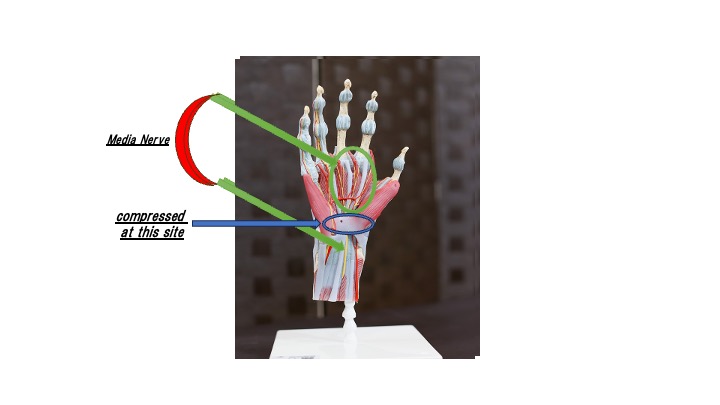
Muscular Approach
The muscles and surrounding tissues along the forearm were assessed in relation to the anatomical course of the median nerve.
Treatment was directed toward areas of increased tension, including the pronator teres, distal biceps tendon region, palmaris longus, and flexor carpi radialis.
Palmar fascial release was also performed.
Before treatment, I explained that temporary changes in the patient’s symptoms, including a short-term increase in numbness, could occur following treatment.
Joint Approach
The mobility of the wrist and carpal bones was assessed, particularly around the scaphoid, lunate, and capitate.
An adjustment was performed with the aim of improving the mobility and functional movement of the wrist.
Immediately after treatment, the patient’s numbness temporarily became stronger, which understandably caused some concern.
Because this possibility had been explained before treatment, we decided to monitor the symptoms and assess her response over the following days.
I recommended that she return within one week so that her response could be reassessed. However, she left without scheduling her next appointment.
[Treatment Outcome]
Second Visit — 2 weeks after the initial treatment
The patient returned two weeks after the initial treatment.
At the time of the visit, her symptoms had returned to approximately their previous level.
However, when we reviewed the period immediately following the first treatment, she reported that the numbness had almost completely disappeared for approximately three days.
For approximately one week after treatment, she felt that the symptoms were about half as severe as they had been before the initial session.
She said:
“I wanted to come back after one week as you suggested, but I couldn’t make it because of work.”
Because she had experienced a clear but temporary reduction in symptoms following the initial treatment, I continued with the same treatment approach and asked her to return one week later.
Third Visit — 1 week later
At the third visit, the numbness was still present but remained at approximately half of its original intensity.
The same treatment approach was continued, and weekly follow-up was recommended so that her response could be monitored more closely.
Fourth Visit — 1 week later
By the fourth visit, the patient reported that she had experienced almost no numbness throughout the previous week.
She was very pleased with the improvement.
The same treatment approach was continued, but because her symptoms had become more stable, I recommended extending the interval between visits to two weeks.
Fifth Visit — 2 weeks later
After extending the interval to two weeks, the patient reported that the numbness had returned somewhat.
During this period, she had been extremely busy at work and had spent long hours typing on her computer.
Although the symptoms were considerably milder than they had been initially, she was understandably disappointed that they had returned.
I explained that an increase in computer work and prolonged repetitive wrist activity could potentially contribute to symptom recurrence.
In addition to the usual treatment, kinesiology taping was applied to the wrist and forearm.
I also showed her how to apply similar tape at home and demonstrated simple forearm massage techniques and wrist exercises that she could perform during bathing and incorporate into her daily routine.
Sixth Visit — 2 weeks later
Two weeks later, the patient returned and reported:
“My symptoms are completely gone!”
She had consistently performed the recommended exercises and had experienced no recurrence of the numbness during the previous two weeks.
Based on her symptom-free period and overall progress, I concluded the intensive treatment phase for her hand numbness.
Seventh Visit and Beyond
The numbness has remained almost completely absent since then, and she no longer needs kinesiology taping in her daily life.
After the symptoms had stabilized, she chose to continue with monthly maintenance care for other chronic musculoskeletal complaints, including lower back pain and shoulder tension.
She has continued this monthly maintenance schedule for more than three years.
[Practitioner’s Opinion]
This patient presented with several findings consistent with carpal tunnel syndrome, including numbness extending from the thumb to the middle finger, worsening symptoms at night and during computer work, a positive Tinel’s sign, restricted wrist mobility, and increased tension in the forearm flexor muscles.
However, hand numbness can have several different causes. Therefore, it is important not to assume that every case of numbness in the hand originates from the carpal tunnel.
In this case, the patient had already been evaluated at a hospital and diagnosed with carpal tunnel syndrome before visiting our clinic. My role was to assess her current musculoskeletal presentation and determine whether conservative chiropractic care was appropriate.
Rather than focusing only on the carpal tunnel itself, I evaluated the relationship between the forearm muscles, wrist joint, and surrounding tissues.
The initial treatment produced a temporary increase in numbness, followed by a noticeable reduction in symptoms over the following days. Although the symptoms later returned, the overall severity gradually decreased with repeated treatment and the addition of home exercises and kinesiology taping.
An important feature of this case was the relationship between symptom recurrence and her workload. When her computer workload increased and she spent longer periods typing, the numbness returned to some degree. This highlighted the importance of considering not only treatment, but also the daily activities and mechanical demands that may contribute to symptom recurrence.
It is also important to clarify that this case should not be interpreted as evidence that chiropractic treatment can replace surgery for carpal tunnel syndrome in general.
Patients with progressive weakness, thenar muscle wasting, significant or worsening sensory loss, or other concerning neurological findings may require further medical evaluation, including appropriate neurological testing and consideration of surgical treatment.
The ability to determine whether a condition is appropriate for conservative care, and when referral to a medical specialist is necessary, is an important part of responsible clinical practice.
In this particular case, the patient’s symptoms improved substantially and remained stable with a combination of chiropractic treatment, home exercises, and modification of contributing activities.
If you are experiencing numbness in your hand, particularly numbness from the thumb to the middle finger, symptoms that worsen during computer work, or symptoms that become more noticeable at night, an appropriate assessment is important.
Spine Chiropractic is located in central Yokohama, just a 1-minute walk from Bashamichi Station, an 8-minute walk from Nihon-Odori Station, a 7-minute walk from JR Kannai Station, and a 12-minute walk from JR Sakuragicho Station.
I provide chiropractic care in both Japanese and English for patients in Yokohama, including Kannai, Bashamichi, Minatomirai, Sakuragicho, and surrounding areas.